Larkin family gymkhana
The Darling Buds of MayThe Larkin family gymkhana is the large country sports day hosted on the Larkins’ meadow, where the effort to stage an orderly public event repeatedly gives way to the family’s improvisation and appetite for fun. Its principal spectacle is Mariette’s assured riding, but the day also gathers the family, The Brigadier, and the harried Miss Pilchester around a competition whose ceremonies Pop cheerfully reshapes. Amid the flags, tents, and races, Cedric Charlton sees Mariette anew, and later that day Pop agrees that she may marry him.
Preparation and Disorder
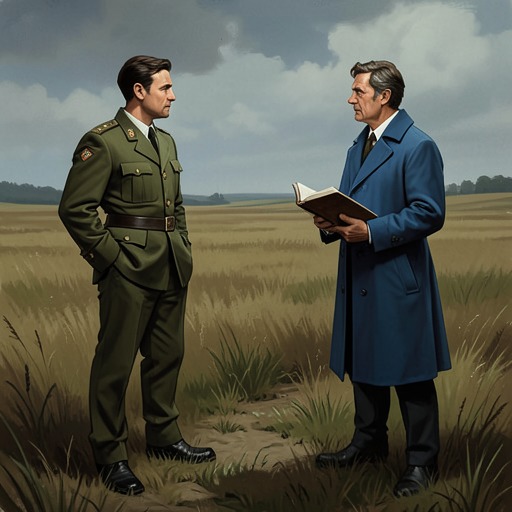
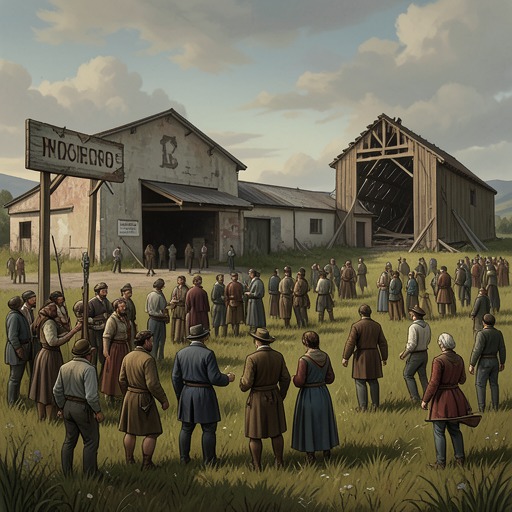
The gymkhana’s morning begins under the pressure of Miss Pilchester’s organizational duties. Five minutes after the earlier confusion, she is moving between tents at a half canter, asking whether the caterers have arrived and where the loudspeaker is. The caterers, in fact, have been on the field since seven and have stopped for tea; the loudspeaker is present, though its wires trip her. She frets over cancelled entries, which ought to have been cancelled by nine, although it is already half-past ten. Her urgent questions about whether the donkeys have arrived meet The Brigadier’s dry observation that some have been there all night, a joke she misses as she rushes off to check whether the ladies’ conveniences have been installed.
The scene’s comedy rests on a collision between a schedule and a day that will not obey it. At half-past eleven the sun finally breaks through, drying the dew on the grass, the trees of Bluebell Wood, and the hedgerows. A forgotten obligation then compounds the disorder: Miss Pilchester has failed to meet the London train at ten forty-five, despite having promised to do so. It is bringing a judge whom the committee specifically requested for his reputation in judging events such as The Horse of the Year Show. The polished machinery of the occasion is already running late before the competitions properly unfold.
The Field and Its Spectators
The weather’s change reshapes the scene. Sunlight reaches the meadow, now dressed with yellow, scarlet, blue, and emerald flags; tents and marquees stand across the new green grass like white haystacks. Near the river, away from the ring, Mariette practices a canter in a yellow shirt and jodhpurs. Watching her, Pop remembers the matter of the baby and wonders mildly whether Cedric knows, then turns back to the day’s immediate rhythms. Ma’s wooden spoon beating on a large jam saucepan announces that it is time to eat. In the midday heat, the sound gathers the event back into the Larkins’ familiar domestic pattern of work, food, and celebration.
All afternoon Cedric watches Mariette enter the riding and jumping events she has chosen. She takes her pony through the walk, trot, canter, and run with faultless composure. Her appearance in the saddle seems almost impossible to reconcile with the more intimate and combative Mariette he knows: the girl who undressed him on the billiard table, fought Pauline Jackson in the strawberry field, and worked alongside him picking strawberries. In the ring, she appears so aristocratic that he imagines her as the niece of Lady Planson-Forbes. The change is not in Mariette but in the view the event affords him: the same person can command a country competition while remaining the impulsive woman of their private life. Cedric, watching, has never been happier.
The family attends as part of the spectacle, not merely as its hosts. The children are properly dressed in riding habits, jodhpurs, and riding caps, although only Mariette and Montgomery will ride. They circulate with enormous pink-and-yellow ice-creams; the twins also have crackling bags of popcorn and potato crisps. Ma wears a pale turquoise silk costume with darker vertical stripes, a broad dark-blue straw hat, matching blue shoes, and stiff little waves in her permed hair. Her turquoise rings have begun cutting into her fingers again, an uncomfortable detail beneath the careful finish of her outfit. Beside her, The Brigadier’s sister retains her familiar appearance in beige shantung and a pink cloche hat. The scene sets the family’s conspicuous pleasure in dressing for the occasion against the plain bodily inconveniences and comic mismatches that its pageantry cannot disguise.
Pop’s Donkey Derby
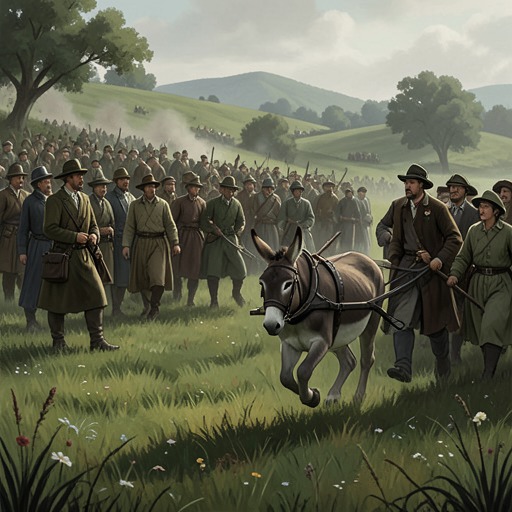
The ladies’ donkey Derby begins as one of Pop’s late, inspired additions to the programme. He persuades the committee that, since he has supplied the field, it owes him this concession. He also produces a silver cup he once bought at a sale for his sideboard. The trophy is engraved for an angling competition, but Pop sees no reason that its former purpose should prevent it serving the present one. The race’s improvised character is thus built into both its creation and its prize: the committee’s formal proceedings make room for Pop’s own definition of what counts as an attraction.
While Ma wanders about with the children and Cedric watches the events, listening proudly whenever the loudspeaker names Miss Mariette Larkin, Pop works behind the beer tent on a reluctant participant. He tries to persuade Miss Pilchester to ride in the Derby. She says she honestly could not, because it would be absolutely ghastly; Pop answers that he thought she liked a bit of fun. His invitation turns the organizer, whose morning has been consumed by the demands of running the event, into a prospective contestant in one of its least decorous attractions. The effort to recruit her captures the gymkhana’s characteristic reversal: responsibility and spectacle keep changing places, while Pop treats embarrassment as an inducement rather than a reason to withdraw.
Marriage and the Day’s Significance
The sports day eventually becomes the setting for a more consequential family decision. During the evening’s fireworks, Cedric tries to speak to Pop while Pop is running among the flower beds with a Golden Rain firework. He tells him that Ma says he may marry Mariette if Pop will let her. Pop answers at once, without hesitation, that he will. The permission arrives in the middle of the celebration, not in a formal conversation set apart from it; Cedric has to ask again to be heard amid the fireworks. In the event’s larger pattern, the answer is of a piece with Pop’s handling of the Derby: he meets an occasion through spontaneous assent rather than ceremony.
The gymkhana therefore binds together two kinds of display. Mariette’s riding gives Cedric a public view of her grace and skill that contrasts with their private history, while the family’s clothes, food, improvised attractions, and Pop’s fireworks keep the event unmistakably theirs. Its scheduled activities repeatedly bend around human appetite and comic disorder, but the day also advances the family’s future: Pop’s consent makes Mariette and Cedric’s marriage possible. The public gathering is at once country entertainment and a turning point in their relationship, with the most important decision made amid the noise and brightness of the festivities.